Questions Homeowners in North Florida Should Ask Before Hiring a Gutter Contractor
If you own a home in North Florida, gutters are not a cosmetic extra. They are part of how your house handles the kind of weather this region gets every year. Between warm-season thunderstorms, high humidity, and the long wet stretch that can bring pounding afternoon rain, a gutter system has to do real work. When it is undersized, poorly pitched, loosely attached, or clogged with leaves and pine needles, the failure usually shows up fast.
That is why hiring the right gutter contractor matters more here than it might in a milder climate. A nice-looking estimate does not tell you whether the installer understands how heavy summer rainfall behaves on a roof in Gainesville, Leesburg, Ocala, or The Villages. It also does not tell you whether the company will steer you toward the right fix, whether that is full replacement, selective gutter repair, or a more practical maintenance plan.
I have seen homeowners ask only one question, “What’s your price?” That question matters, of course, but it is rarely the one that protects the house. The better approach is to ask a few pointed questions that reveal how a contractor thinks, how they build, and whether they are solving your actual drainage problem.
Start with the most important question: what problem are we solving?
Not every home needs the same thing. Some houses need full gutter installation in North Florida because they never had an effective system to begin with. Others have sections pulling away from the fascia, leaking seams, or overflowing at one corner where debris packs tightly. In older neighborhoods with mature trees, it is common to see a perfectly decent gutter fail simply because acorns, oak leaves, pine needles, and small twigs keep choking the flow.
A reliable contractor should be able to walk the property and explain the problem in plain language. Maybe the gutters are too small for the roof area. Maybe the downspouts are not carrying enough water away during summer downpours. Maybe one run has settled and lost its pitch. Maybe the issue is less about installation and more about ongoing gutter maintenance in Florida, where debris and humidity can create a cycle of clogging, staining, and overflow.
If the contractor jumps straight to a full replacement without explaining what has gone wrong, slow the conversation down. Ask what they are seeing and why. A homeowner deserves to know whether they need seamless gutter installation in Leesburg FL, spot gutter repair in Gainesville FL, or routine gutter cleaning and repair in Ocala FL.
Ask whether seamless gutters make sense for your home
This is one of the best questions you can ask because it gets past sales language and into performance. Seamless gutters are popular for a reason. Fewer joints generally mean fewer places for leaks to develop. That does not make them magic, and a good contractor will say so. A poor pitch, weak attachment, or bad drainage plan can still create problems. But in a rainy, humid region, reducing seams is often a practical advantage.
When people ask about seamless gutters in Gainesville FL or seamless gutter installation in Leesburg FL, what they usually want to know is whether the added cost is worth it. The answer often depends on the current state of the system and the tree cover around the home. If you have a lot of debris dropping from live oaks or pines, fewer joints can help reduce snag points and leak risks over time. On the other hand, seamless gutters still need cleaning, and they still need proper design.
A capable installer should be willing to explain where seamless runs help, where downspout placement matters just as much, and what trade-offs come with the material and layout choices. If the answer sounds like a memorized pitch, keep asking.
What materials and guard options do you recommend for this roof and this tree cover?
North Florida homes deal with a messy combination of hard rain and steady debris. That is why this question matters. There are several common gutter guard styles on the market, including brush, foam insert, mesh screen, micro-mesh, PVC covers, and reverse-curve designs. None of them is a universal winner.
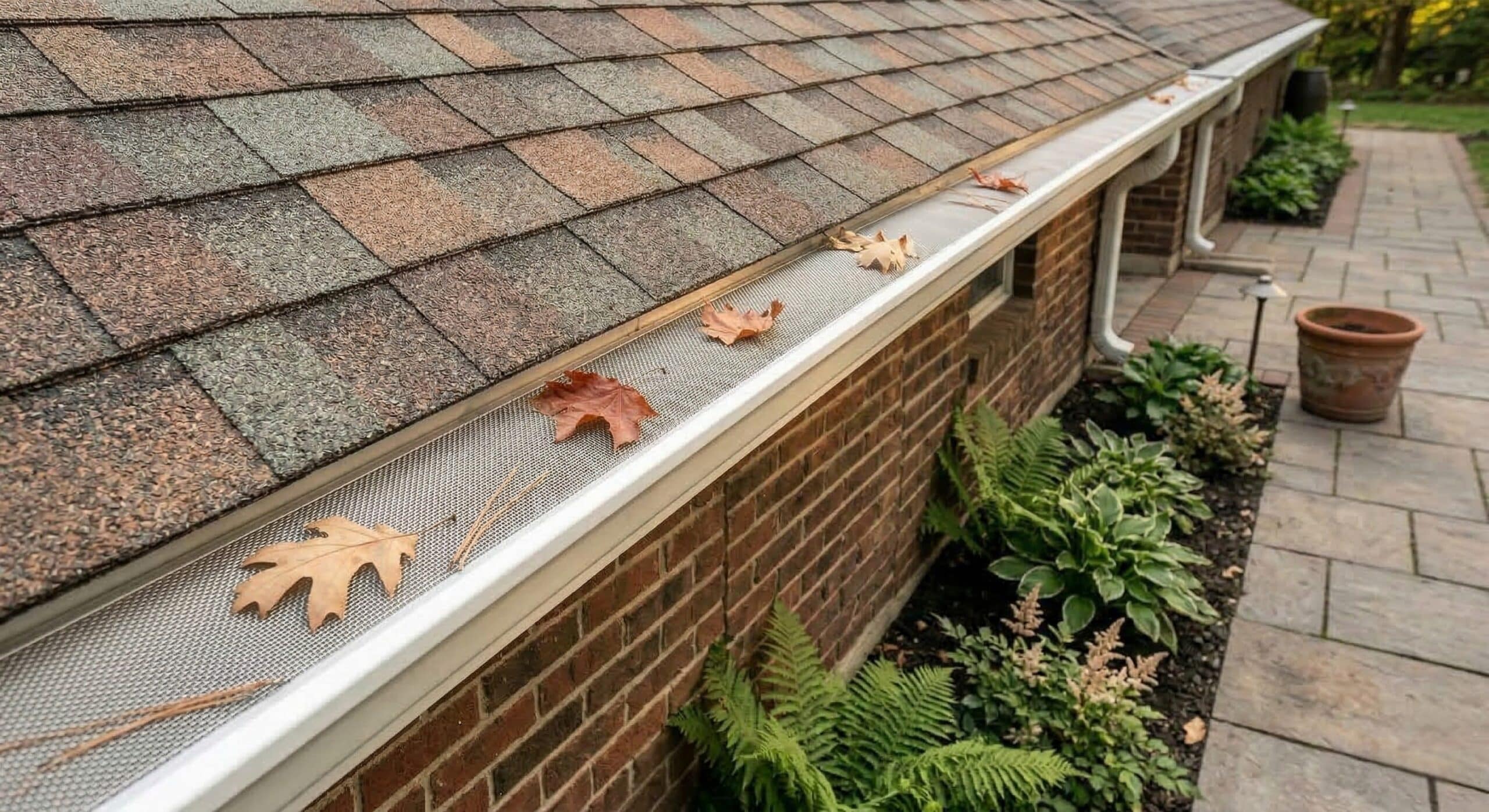
A contractor who actually works in this region should be able to talk through how different guard styles behave when exposed to oak leaves, acorns, pine needles, and small limbs. This is where experience shows. A mesh or micro-mesh option may appeal to one homeowner because it blocks finer debris. Another property may need a different solution because of roof conditions, surrounding trees, or maintenance expectations. Some homeowners want the lowest up-front cost. Others want fewer service visits, even if the initial investment is higher.
This is also the point where you should ask directly about gutter guard installation in Central Florida and how much maintenance guards really reduce. Be careful with absolute promises. Guards can help, but no honest contractor should tell you that your gutters will never need attention again. Florida’s wet season and heavy organic debris are simply too real for that kind of claim.
How do you design for Florida rain, not just average rain?
This question separates thoughtful installers from basic labor crews. North and Central Florida are not dry climates with occasional storms. Warm-season thunderstorms are routine, and tropical moisture can bring intense bursts of rain. Flooding rain is not a rare, dramatic exception. It is a recurring concern during the wet season.
That means gutter design should account for the reality of fast, heavy roof runoff. A contractor should talk with you about how water moves off your roof during a hard summer storm, where downspouts discharge, and whether problem corners or valleys need special attention. If a company seems unconcerned about local rainfall patterns, that is a warning sign.
I have noticed that homeowners often focus on whether water is getting into the gutter, while the real issue is where the water goes after that. You can have a decent gutter run and still end up with concentrated drainage in the wrong place. If the contractor does not inspect those exit points, the assessment is incomplete.
Can you show me where repairs make sense and where replacement makes more sense?
This is a smart budget question, and it invites an honest answer. Some systems really can be repaired. If one section leaks, one fastener line has loosened, or one downspout connection has failed, gutter repair in Gainesville FL may be all you need. In other cases, patching one problem after another becomes false economy.
A seasoned gutter contractor in Central Florida should be able to explain that difference without pressure. They should be able to point to sections that are still serviceable and sections that are past the point of reliable repair. Homeowners often appreciate that kind of candor because it feels practical, not sales-driven.
Repairs also need to be considered in context. If your biggest issue is recurring clogs from tree debris, a repair alone may not stop the problem. You may need a repair plus a maintenance plan, or repair plus gutter guards in Gainesville FL if the site conditions support it. If your current gutters are older sectional runs with multiple weak spots, replacement with seamless gutters may be the cleaner long-term fix.
What does your maintenance advice look like after installation?
A contractor who installs and disappears is not doing homeowners any favors. In this part of Florida, maintenance is part of ownership. Leaves, pine needles, acorns, and small limbs are common enough that every homeowner should expect some amount of upkeep. Keeping that debris out of drainage paths matters not only for protecting the house, but also for preventing clogging and runoff issues around the property.
Ask what maintenance the contractor recommends after installation. Ask how often gutters should be checked, what signs of clogging or overflow to watch for, and whether guards change the maintenance schedule or simply reduce the frequency of cleaning. An honest answer will be specific without pretending to predict every property exactly.
A heavily shaded lot in Gainesville may need a different schedule than a more open property near The Villages. That is why blanket promises are so unhelpful. A good contractor should look at the actual tree cover and roofline before making recommendations. If you are already searching for gutter cleaning Leesburg FL or gutter cleaning and repair Ocala FL every season, that tells you something about the debris load your system is handling.
Ask how they handle existing problem spots around the home
Some homes have one stubborn area that keeps failing. It may be a roof valley that dumps too much water into one short run. It may be a rear corner where pine needles gather and compact. It may be a front entry where overshoot during a thunderstorm leaves water pouring near a walkway.
These are the places where experience matters. You want a contractor who pays attention to how the whole system behaves, not just how it looks on install day. The best conversations usually happen when the homeowner walks the property and points to the exact places where overflow, dripping, staining, or pooling has happened in real storms.
A skilled installer will not dismiss those details. They will use them. They may explain that the issue comes from debris buildup, from insufficient capacity, from poor pitch, or from a discharge point that needs to move. What matters is that they are solving a drainage behavior, not just attaching metal to the fascia.
A short list of questions worth bringing to the estimate
You do not need a huge checklist. You just need questions that reveal whether the contractor is thinking clearly.
- What specific problem do you see with my current gutter system?
- Do you recommend repair, full replacement, or added protection like guards, and why?
- How will this design handle heavy North Florida rain during summer storms?
- What maintenance should I expect with this setup on my tree-covered lot?
- Are there any areas of my roofline or drainage path that concern you?
That short list tends to produce much better conversations than asking about price alone.
Be careful with guarantees that sound too clean
Florida conditions are messy. Debris falls. Rain hits hard. Humidity hangs around. Any contractor promising a perfectly maintenance-free system for life is overselling. Better to work with someone who talks in practical terms.
For example, gutter guards can reduce the amount of debris getting into the trough, but they do not erase maintenance forever. Seamless systems reduce seam-related leak points, but they still depend on proper sizing, pitch, and support. Repairs can extend life, but they cannot always undo years of wear or a flawed original layout.
Trust the contractor who explains limitations as clearly as benefits. That usually signals experience.
Local experience matters, but only if it shows up in the details
A company can say it serves Leesburg, Gainesville, Ocala, The Villages, or Central Florida all day long. The real question is whether local knowledge changes the recommendation. It should.
Someone familiar with gutters in The Villages FL may talk with you about managing runoff on a lot with a particular roof shape and moderate landscaping. A contractor used to seamless gutters in Gainesville FL should understand what heavy tree debris can do over a season. A team handling seamless gutter installation in Leesburg FL should be able to discuss how repeated summer rain can expose weak pitch or poor downspout placement quickly.
This is not about regional branding. It is about whether the recommendation sounds grounded in North Florida weather patterns and normal local debris loads. If it does, that is a good sign.
Ask what happens if you do nothing for another year
This question often leads to the most honest answer of the entire visit. A careful contractor will tell you whether the issue is urgent, manageable, or mostly preventive. That is useful because not every gutter problem is an emergency, but some become expensive if ignored through another wet season.
If the gutters are already clogging and overflowing during frequent storms, waiting can mean more than inconvenience. Water going where it should not go tends to find a weak point sooner or later. If the system has loosened sections or recurring leaks at joints, another rainy season may turn a repairable issue into a replacement issue.
At the same time, a trustworthy contractor should not invent urgency where there is none. If a good cleaning and a few targeted repairs are enough for now, that is worth hearing too.

The contractor should be able to explain gutter guards without oversimplifying them
This subject deserves more nuance than it usually gets. Homeowners often ask for gutter guards because they are tired of cleaning. That is understandable. But the right question is not, “Do guards work?” It is, “Which guard, on this house, with these trees, and what maintenance remains afterward?”
That is especially relevant for gutter guards Gainesville FL and gutter guard installation Central Florida, where a home may deal with fine pine debris one month and larger leaf drop the next. Some guard types are better suited to certain debris patterns than others. A contractor does not need to lecture Larrys Gutters you on every product in existence, but they should be able to explain why they favor one style over another for your property.
If they cannot explain that clearly, they may be selling inventory rather than solving your problem.
A few answers that should make you pause
Sometimes the red flags are not dramatic. They are subtle signs that the contractor is not really assessing the job.
- “All houses need the same setup.”
- “Gutter guards mean you’ll never clean again.”
- “We don’t need to talk about your tree cover.”
- “Any leaks can just be caulked.”
- “The only thing that matters is the lowest price.”
Each of those answers skips over a real condition that affects performance in Florida.
Price matters, but value lives in the details
Homeowners should absolutely compare prices. Just compare the right things. A lower estimate may leave out problem areas, skimp on the design conversation, or ignore whether your home needs protection from debris as much as it needs a new gutter run. A higher estimate is not automatically better either. It may include work you do not need.
What you want is a contractor who can justify the recommendation. If they say you need gutter installation in North Florida, they should be able to explain why repair is no longer enough. If they recommend seamless gutters, they should explain where the performance benefit comes from. If they recommend guards, they should discuss realistic maintenance afterward.
That kind of specificity is what gives an estimate meaning.
The best hire usually feels less like a sales call and more like a site evaluation
By the end of the conversation, you should have a clearer picture of your roof drainage, your debris problem, and your options. You should know whether you are dealing with a repair issue, a replacement issue, or a maintenance issue that has been mistaken for both. You should also have a sense of whether the contractor respects the realities of Florida weather instead of talking around them.
That matters for homeowners in Leesburg, Gainesville, Ocala, The Villages, and across the surrounding region. The houses may differ, but the pattern is familiar. Heavy rain exposes weak systems. Tree debris clogs neglected ones. Humidity and wet seasons punish shortcuts.
The right questions help you spot the contractor who understands that. And once you find that person, the decision gets a lot easier.
Larry's Gutters
Leesburg location
1720 Leesburg Commons Ct, Suite 2
Leesburg, FL 34748
Phone: (352) 460-0450
Gainesville location
1024 S Main St, Bldg B
Gainesville, FL 32601
Phone: (352) 460-0450
Website: https://larrysgutters.com